
Making hydrogen work for Poland: Four insights from our expert roundtable in Warsaw
About the project
As Europe’s third-largest hydrogen producer and consumer, Poland will need clean hydrogen to keep its major industries competitive and aligned with climate goals - yet today the country produces almost no renewable hydrogen.
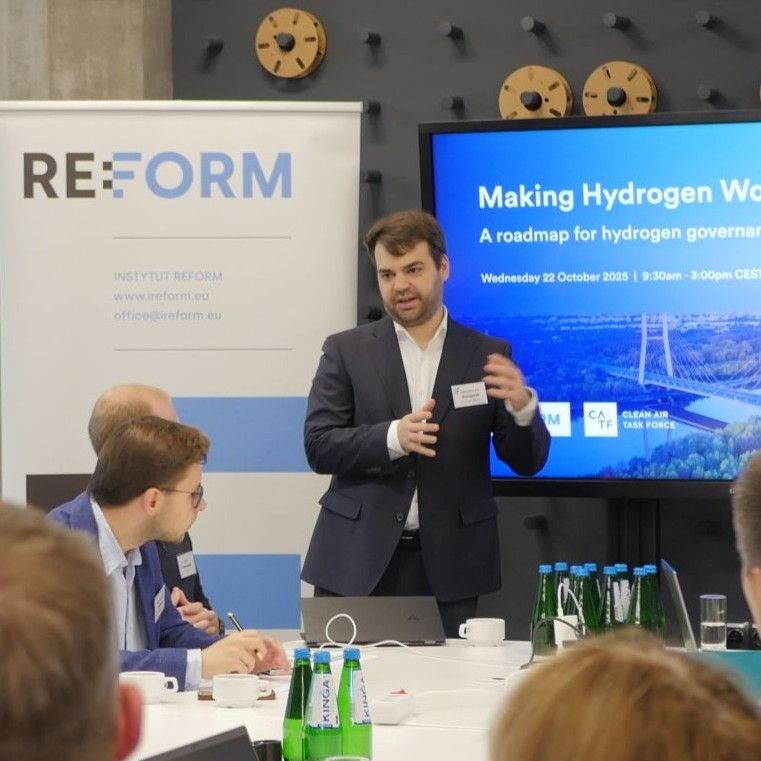
With major regulatory deadlines approaching, Poland is at a pivotal moment and must choose a pathway for clean hydrogen that reflects its national realities. To explore these challenges, CATF and the Reform Institute convened a roundtable in Warsaw with stakeholders from government and industry. The discussion focused on how Poland can scale clean hydrogen without slowing its net-zero transition or harming industrial competitiveness.
Hydrogen policy is out of step with industrial needs
Poland’s hydrogen use is concentrated in emissions-intensive sectors like refining and chemicals, with steelmaking likely to follow. Under REDIII, Poland is expected to use at least 180 kt of renewable hydrogen in industry by 2030 - five times today’s total EU renewable hydrogen output. But limited renewable energy, a carbon-heavy grid, and high electricity prices make large-scale renewable hydrogen unviable in the near term.
Industry representatives warned that switching too quickly to costly renewable hydrogen could erode competitiveness. CATF’s modelling shows that while renewable hydrogen will be essential later on, low-carbon hydrogen with CCS is the only scalable, affordable option today and can cut emissions while Poland works to decarbonise its power system.
Stakeholders broadly agreed that hydrogen deployment will require integrated infrastructure, stable funding, administrative capacity, and flexible policy design.
Industrial clusters as the starting point
Deploying low-carbon hydrogen within existing industrial clusters can anchor CO₂ transport and storage infrastructure, reduce costs, and accelerate emissions reductions. Aligning hydrogen planning with carbon management strategies will help identify priority sites and direct limited funding more effectively. Participants stressed that funding should target overall emissions reductions rather than favouring specific technologies.
Current EU rules recognise only renewable hydrogen for meeting targets, which risks sidelining countries like Poland. Stakeholders emphasised that real emissions cuts - not prescriptive production pathways - must guide hydrogen deployment to maintain competitiveness and meet climate obligations. Achieving this will require more flexible EU rules, stronger national coordination, and clear institutional responsibilities.
A moment for strategic reset
Poland’s 2021 Hydrogen Strategy prioritised new hydrogen markets but did not reflect today’s industrial realities. Participants agreed that the upcoming strategy update must clearly define priority uses, timelines, and responsible institutions, and integrate hydrogen deployment into broader industrial decarbonisation plans.
Key takeaways
- Embed hydrogen in industrial decarbonisation policy, ensuring consistency across national strategies such as PEP2040 and the updated NECP.
- Ensure flexibility and a portfolio approach to technology, enabling Poland to meet climate goals using the most cost-effective tools.
- Balance climate ambition with economic competitiveness, supporting industrial clusters and allowing adaptable implementation.
You can find CATF presentation by following this link and Reform Institute's by following this link.